Tennis Score Pronunciation Quiz
How to Pronounce Tennis Scores
Learn the official way to say tennis scores like a pro. Remember: scores are never read as "30/30" or "40/40" - always use the correct terminology.
Score to Pronounce
Scored: 0/0Ever sat through a tennis match and heard the umpire say "thirty-all" instead of "30/30"? You’re not alone. Most people assume the score is just read as numbers - 30-30, 40-15 - but that’s not how it works on the court. The way tennis scores are spoken is one of the game’s quirkiest traditions, and if you’ve ever been confused by it, you’re not missing anything obvious. It’s just not written the way it’s said.
Why Isn’t It Called "30/30"?
Tennis scoring doesn’t follow logic you’d expect from math class. The system goes: 0 (love), 15, 30, 40, then game. There’s no 45, no 50, no 60. And when both players have the same score, you don’t say "30/30" or "40/40." You say "thirty-all" or "forty-all." That’s it. The slash doesn’t exist in spoken tennis.This isn’t a mistake. It’s been this way for centuries. The origins trace back to medieval France, where the scoring was based on clock faces - each point moved the hand by 15 minutes. That’s why you see 15, 30, and 40. The 40 instead of 45? Legend says it was shortened to avoid saying "forty-five" right before "game," which would’ve been too long. The "all" part? That’s just English for "equal." So "thirty-all" means both players have thirty. Simple.
What You Actually Hear on Court
Here’s how real tennis matches sound:- Score is 0-0? The umpire says, "Love-all."
- Player A has 15, Player B has 0? "Fifteen-love."
- Both at 30? "Thirty-all."
- Both at 40? "Forty-all."
- Deuce? That’s when it goes past 40-all - "deuce" is the call, not "40/40."
Notice something? No numbers are ever paired with a slash. No "30/30." No "40/40." Even in professional tournaments like Wimbledon or the US Open, you’ll never hear an official say "thirty slash thirty." That’s a mistake made by beginners, TV commentators who aren’t tennis purists, or people watching without knowing the rules.
What Happens After Forty-All?
Once both players hit 40, the score isn’t called "forty-forty" - it’s called "deuce." That’s the official term. From there, a player must win two consecutive points to win the game. The first point after deuce is called "advantage" - "advantage In" if the server wins it, "advantage Out" if the receiver does. If the player with advantage loses the next point, it goes back to deuce. It can go on forever - that’s why tennis matches can stretch longer than expected.So if you hear "deuce," you’re not hearing a random word. You’re hearing the moment the game gets tense. It’s the only time in tennis where the score doesn’t reset - it just loops. And no, you don’t say "40/40" here either. Ever.
Why Do People Get This Wrong?
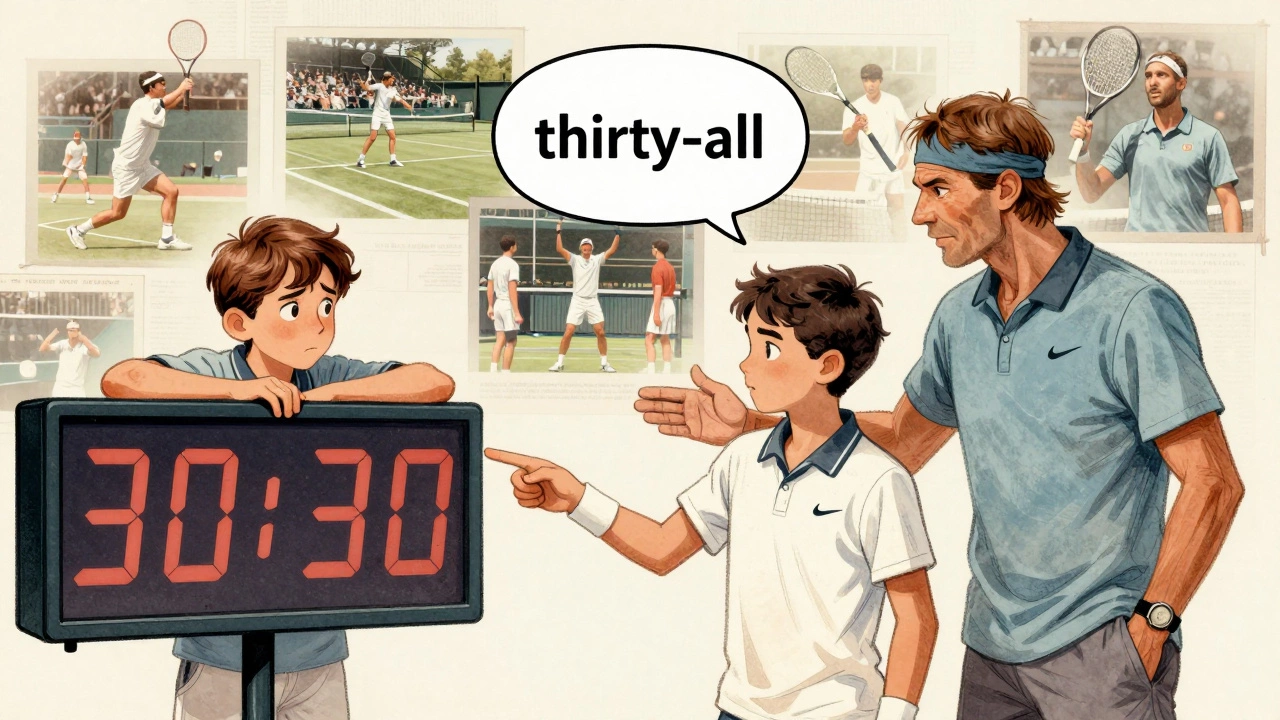
Most people learn tennis from TV or video games. In video games, scores are displayed as numbers: 30-30, 40-15. In broadcasts, some commentators slip up and say "thirty-thirty" or "forty-forty" to make it sound more modern. But the real rules haven’t changed. The International Tennis Federation (ITF) has clear guidelines: scores are always called using the traditional terms.Even in junior tournaments in Bangalore or Delhi, you’ll hear coaches correct kids who say "30/30." They say, "Say it like the pros - thirty-all." It’s not about being old-fashioned. It’s about precision. Tennis is a game of nuance - the call matters as much as the shot.
How to Sound Like a Pro
If you want to fit in at your local club or sound smart while watching the Australian Open, remember this:- Never use a slash. Say "thirty-all," not "30/30."
- Use "love" for zero. "Love-all," "fifteen-love," "love-forty."
- After 40-40, it’s always "deuce," never "forty-forty."
- After deuce, say "advantage" followed by "In" or "Out," not "player one up."
It’s not hard. It just takes practice. Try saying it out loud the next time you’re watching a match. Say "thirty-all" when the score is tied at 30. Say "deuce" when it’s tied at 40. You’ll start noticing how often people get it wrong - and you’ll be one of the few who actually know how it’s done.
Is This Rule the Same Everywhere?
Yes. Whether you’re in Melbourne, Paris, New York, or Bangalore, the scoring terminology is standardized by the ITF. The rules don’t change based on country or language. Even in non-English-speaking countries, the terms "love," "fifteen," "thirty," "forty," and "deuce" are used universally - often pronounced in English because that’s how the game was codified.Some local tournaments might let players say "zero" instead of "love," but even then, "thirty-thirty" is still not accepted. The official call is always "thirty-all." No exceptions.
Why Does This Tradition Still Exist?
You might wonder - why keep an old system when modern sports use simple numbers? Tennis holds onto its traditions because it’s part of its identity. The scoring system isn’t just about counting points - it’s about rhythm, history, and respect for the game’s roots.Think of it like golf’s "birdie" or "eagle," or baseball’s "double play." These terms aren’t practical - they’re cultural. Saying "thirty-all" connects you to players from 1870, to Borg, to Nadal, to today’s rising stars in Chennai or Mumbai. It’s not just a score. It’s a language.
What If You Say "30/30" by Accident?
No one will kick you out of the club. But you might get a polite smile - or a gentle correction from a seasoned player. In casual matches, people don’t care. In tournaments, especially junior or club-level ones, officials and coaches will notice. And they’ll remember.The good news? Once you learn it, you’ll never forget. And you’ll start hearing the difference in every match you watch. You’ll catch yourself thinking, "Oh, they said ‘forty-forty’ - that’s wrong," and you’ll know why.
It’s not about being perfect. It’s about understanding. Tennis isn’t just about who hits the ball harder. It’s about who knows the game - inside and out.