Rugby History Timeline
Explore the key moments that shaped rugby from its controversial origins to the global sport we know today.
The game of rugby didn’t just appear out of nowhere. It wasn’t dreamed up in a boardroom or designed by committee. It was born from a single moment of rebellion, a burst of energy on a school field in England, and it changed sports forever. If you’ve ever watched a rugby match - the tackles, the scrums, the wild sprints down the sideline - you’ve seen the legacy of that moment. But where did it all start? The answer isn’t complicated, but it’s often misunderstood.
The Moment That Started It All
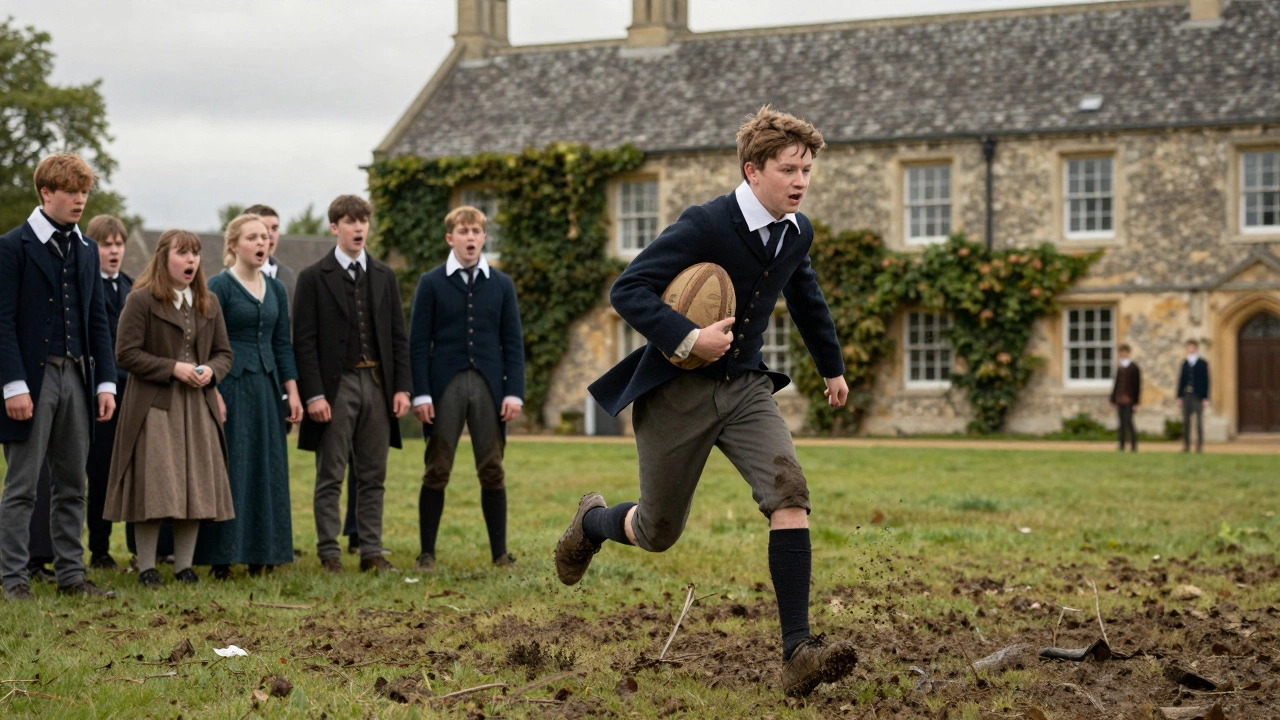
In 1823, at Rugby School in Warwickshire, England, a 16-year-old boy named William Webb Ellis did something that broke the rules of the time. During a football match - which back then was more like a chaotic kick-and-chase game - Ellis picked up the ball and ran with it. No one had done that before. The rules said you could only kick the ball. But Ellis didn’t care. He ran. And that act, whether legendary or exaggerated, became the spark.
It wasn’t an instant revolution. For years, the idea of carrying the ball was just a local quirk at Rugby School. Other schools played their own versions of football. But by the 1840s, former students from Rugby School started taking the rules with them to universities and clubs. The game evolved. The oval ball became standard. The try, the conversion, the drop goal - all of it took shape in those early decades.
Why England, Not Another Country?
People sometimes wonder: could it have been Wales? Scotland? Australia? After all, those countries are now rugby powerhouses. But the origin isn’t about who plays it best today - it’s about who first broke the mold.
England in the early 1800s was the center of organized school sports. Public schools like Eton, Harrow, and Rugby had their own rules. Football wasn’t standardized. Each school had its own version. Rugby School’s version, with its allowance to run with the ball, stood out because it was written down and passed on. Other schools didn’t document their variations the same way.
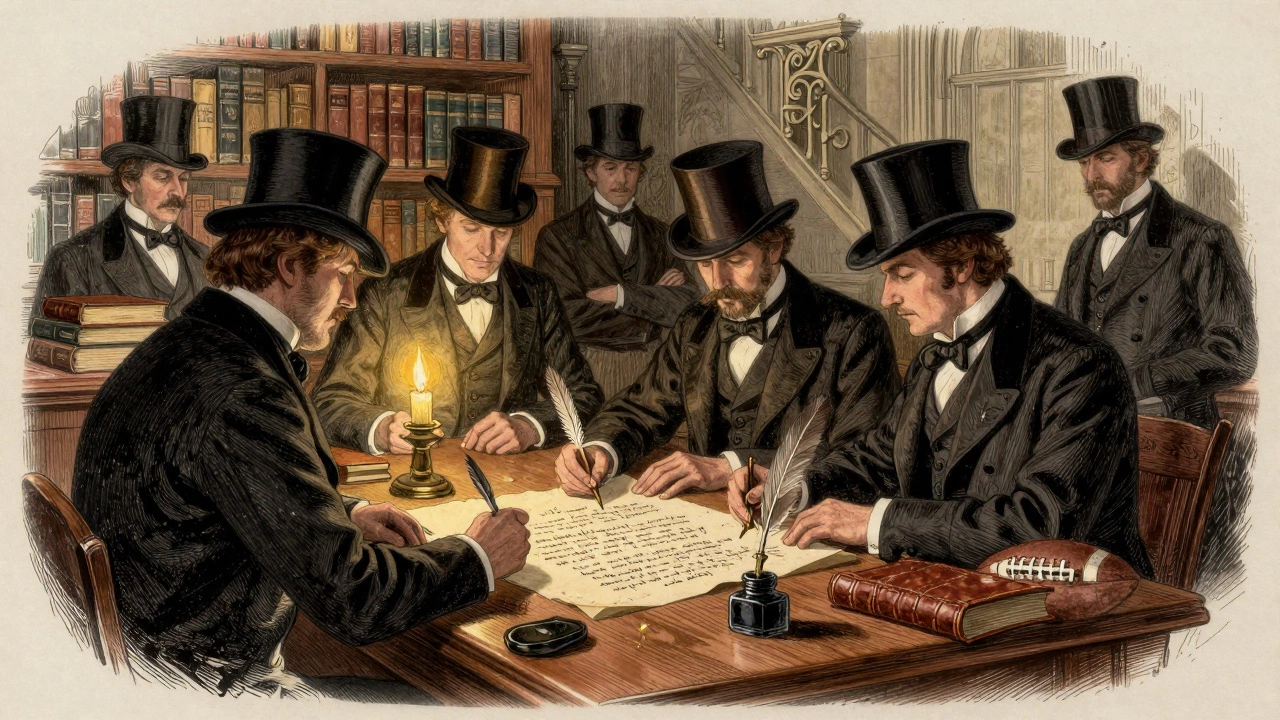
By 1845, Rugby School students wrote down the first official set of rules for their game. That’s the first time the rules of rugby were codified. That’s the moment it stopped being a playground habit and became a sport.
The Birth of the Rugby Football Union
As the game spread, so did disagreements. Some clubs wanted to keep running with the ball. Others wanted to stick closer to soccer-style rules. In 1871, 21 clubs from across England met at the Pall Mall Restaurant in London. They formed the Rugby Football Union the first governing body for rugby, founded in 1871 to standardize rules and organize matches. That’s when rugby became a formal sport with national structure.
Before that, there was no official international play. After that, it exploded. The first international match happened just a year later - in 1872 - between England and Scotland. That game was played at Raeburn Place in Edinburgh. Scotland won. But it was England’s rules that were used.
Rugby’s Spread and the Split
Once the game had structure, it traveled fast. British soldiers, sailors, and teachers took it to colonies and allied nations. By the 1880s, rugby was being played in New Zealand, Australia, South Africa, and France. Each region added its own flavor - the All Blacks’ haka, the Springboks’ physicality, the French flair for open play.
But not everyone agreed on how the game should evolve. In 1895, a major split happened in northern England. Clubs in Yorkshire and Lancashire wanted to pay their players. The Rugby Football Union said no - it was supposed to be amateur. So 22 clubs broke away and formed the Northern Rugby Football Union a breakaway group formed in 1895 that eventually led to the creation of rugby league. That group later became rugby league - a faster, more professional version of the game.
From then on, there were two types of rugby: rugby union (the original, still governed by World Rugby) and rugby league (with different rules and fewer players). Both trace back to that same school field in 1823.
Why This Matters Today
When you watch a rugby fixture - whether it’s the Six Nations, the Rugby Championship, or the World Cup - you’re watching a game shaped by one boy’s decision to break the rules. The sport didn’t come from a corporate strategy or a TV network. It came from a kid who thought, “Why not?”
That’s why the Rugby World Cup trophy is called the Webb Ellis Cup. It’s not just a name. It’s a tribute to the moment everything changed.
Today, rugby is played in over 120 countries. Millions of people play it. But only one country can claim its birthplace: England. Not because it invented football. Not because it was the strongest. But because it was the first to allow the ball to be carried - and then wrote it down so others could follow.
Common Misconceptions
Some people think New Zealand invented rugby because the All Blacks are so dominant. Others assume South Africa did, because of their physical style and World Cup wins. Australia’s Wallabies have a rich history too. But none of them created the game. They perfected it.
There’s also a myth that rugby was invented as a punishment - that Webb Ellis was forced to run with the ball as discipline. That’s not true. There’s no evidence of that. The story is about a spontaneous act, not a penalty.
And while Wales and Scotland helped shape the early international game, they didn’t invent the rules. They adopted them - and then made them better.

What You Can See Today
If you visit Rugby School today, you’ll find a plaque outside the old playing field. It reads: “This stone commemorates the exploit of William Webb Ellis who with a fine disregard for the rules of football as played in his time first took the ball in his arms and ran with it.”
The school still plays rugby. The pitch is smaller than modern fields. The rules are slightly different. But the spirit is the same. And every time a player picks up the ball and runs, they’re following in the footsteps of a 16-year-old boy from 200 years ago.
How Rugby’s Origin Shapes the Game Today
The fact that rugby started with a single act of rule-breaking explains a lot about how the game is played today. There’s no offside rule in the same way as soccer. Tackling is central. The scrum is a messy, physical reset - not a clean restart. That’s because the game was never meant to be tidy. It was meant to be raw, physical, and unpredictable.
Modern rugby still rewards courage, improvisation, and individual brilliance. That’s why a player like Jonah Lomu could dominate a World Cup final, or why a last-minute drop goal can win a match. The game hasn’t been sanitized. It still carries the DNA of that first run.
Even the scoring system reflects its origins. A try - worth five points - was originally just a way to earn the right to kick for goal. The kick was the real prize. Over time, the try became more valuable, but the name stuck. It’s a living relic.
Final Answer
England invented rugby. Not because it had the best players. Not because it had the most fans. But because a boy at Rugby School in 1823 decided to break the rules - and someone else decided to write them down. That’s how sports change. Not through grand plans, but through one person saying, “I’m going to do it differently.”
That’s why, when you watch a rugby fixture, you’re not just watching a game. You’re watching history in motion.
Who invented rugby and when?
William Webb Ellis, a student at Rugby School in England, is credited with inventing rugby in 1823 when he picked up the ball and ran with it during a football match. The first official rules were written in 1845 by students at the same school.
Is rugby older than soccer?
The earliest forms of football date back centuries, but modern soccer (association football) was codified in 1863 by the Football Association in England. Rugby’s rules were written in 1845, making it one of the first organized forms of football to be formally defined - though both sports evolved from similar medieval ball games.
Did Wales or Scotland invent rugby?
No. Wales and Scotland were among the first countries to play international rugby matches - Scotland played England in the first official test match in 1871 - but neither invented the game. The rules originated at Rugby School in England.
Why is the World Cup trophy called the Webb Ellis Cup?
The trophy is named after William Webb Ellis to honor the moment he broke the rules by running with the ball in 1823. The name was officially adopted in 1987 when the first Rugby World Cup was held, recognizing the origin of the sport.
Is rugby league the same as rugby union?
No. Rugby league split from rugby union in 1895 over the issue of paying players. League has 13 players per side, faster play, and different scoring rules. Union has 15 players, more complex set pieces, and remains amateur in its amateur era traditions. Both trace back to the same origin in England.
Can you visit the birthplace of rugby?
Yes. Rugby School in Warwickshire, England, still exists. Outside the original playing field, there’s a stone plaque commemorating William Webb Ellis’s action in 1823. The school continues to play rugby and welcomes visitors interested in the sport’s history.