
Handicap Stroke Calculator
| Hole | Par | Stroke Index | Get Stroke? | Net Par Target |
|---|
How to read this:
If you receive a stroke on a hole (marked Yes), your target score to break even with par is your Net Par Target. For example, on a Par 4 where you get a stroke, shooting a 5 counts as a 'Par' in net scoring.
You’ve heard it on the course. Maybe a friend said it, or you saw it in a casual group chat. "I'm a 5." Or perhaps someone mentioned the "5 rule" when discussing handicaps or betting stakes. If you are standing on the first tee wondering what this actually means, you are not alone. The term "5 rule" is one of those golfing phrases that sounds official but is often misunderstood. It usually doesn't refer to a specific rule in the Rules of Golf governed by the governing bodies like the R&A and USGA. Instead, it almost always points to one of two things: being a player with a handicap index of 5, or a misunderstanding of how scoring adjustments work.
In this guide, we will clear up the confusion. We’ll look at what it really means to be a "5," how handicaps actually work, and why there is no secret "Rule 5" that changes the game for mid-handicappers. Whether you are trying to understand your own score or just want to keep up with the conversation, this breakdown will help you navigate the numbers.
The "Handicap 5" Identity
When golfers talk about the "5 rule" or simply say they are a "5," they are referring to their Handicap Indexa numerical representation of a golfer's potential ability. A handicap of 5 is significant. It places a player firmly in the category of "good amateur golfer." You are better than the average recreational player (who typically has a handicap between 14 and 20), but you are not yet a scratch golfer (handicap 0) or a low-single-digit expert.
So, what does playing as a 5 actually look like on the course?
- Consistency: You rarely triple-bogey. Your bad holes are usually bogeys, occasionally double bogeys.
- Greens in Regulation: You hit about 60-70% of greens in regulation. You know where your clubs go most of the time.
- Putting: You make most of your putts under 10 feet. Three-putting is rare.
- Scoring: On a par-72 course, you might shoot a 77 or 78 net (after taking your handicap strokes). Gross scores often hover around 80-85 depending on the course difficulty.
Being a 5 means you have mastered the fundamentals. You don’t need lessons every week; you need practice and course management. This status often comes with unspoken expectations in match play. If you are a 5, people expect you to compete against other single-digit players. They do not expect you to crush a scratch golfer, nor do they expect you to lose easily to an 18-handicapper.
Is There an Actual "Rule 5" in the Official Rules?
If you pick up the official Rules of Golf bookthe comprehensive set of regulations published by the R&A and USGA, you will find there is no "Rule 5" that dictates special treatment for 5-handicappers. In fact, the structure of the rules changed significantly in 2019, consolidating many sections. Currently, the rules are organized into 24 main rules, covering topics from conduct to equipment.
Historically, older versions of the rules did have different numbering systems, but even then, "Rule 5" never referred to a specific privilege for mid-handicappers. For example, in pre-2019 rules, Rule 5 dealt with "The Player"-covering conduct, caddies, and assistance. It had nothing to do with score adjustments based on a handicap of 5.
Why does the myth persist? It likely stems from casual betting games or modified formats like "Net Stableford" or "Par/Bogey" games where handicaps are applied. In these formats, a player with a 5 handicap gets 5 extra strokes distributed across the hardest holes on the course. This isn't a "rule" in the regulatory sense; it’s a method of calculation to level the playing field.
How Handicap Strokes Are Applied (The Real Mechanism)
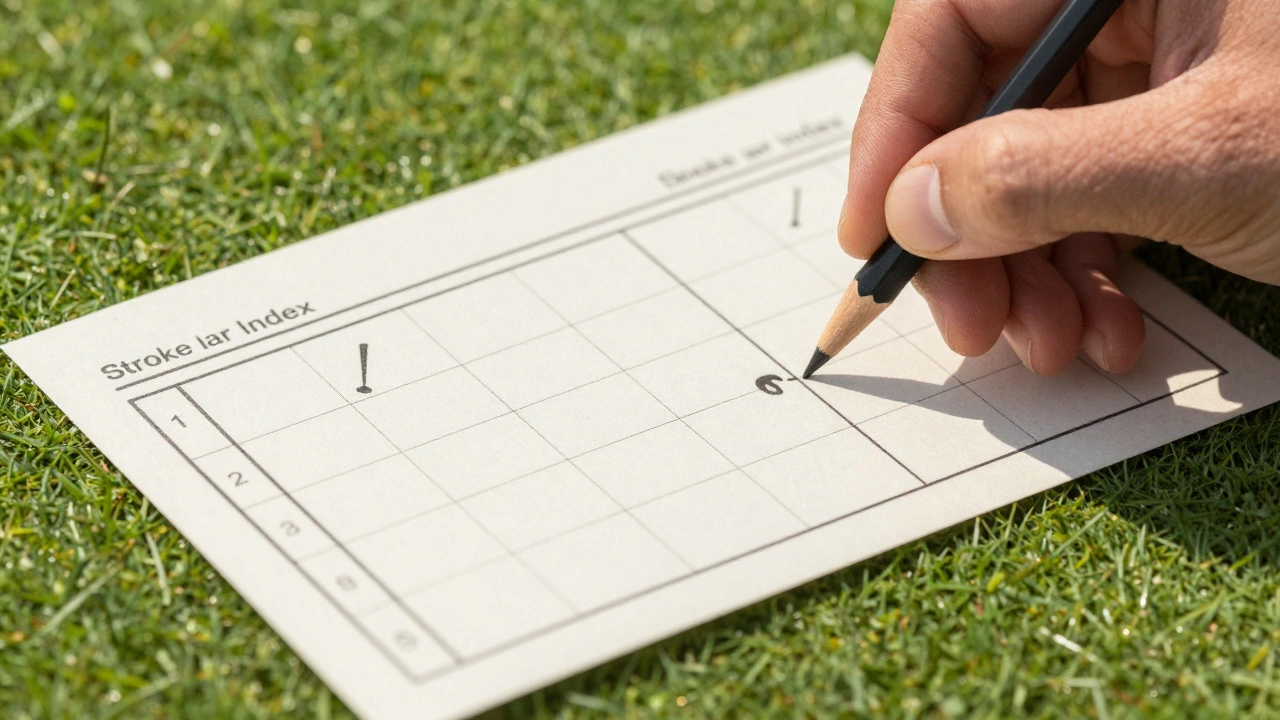
To understand why a 5 matters, you need to understand how those 5 strokes are given. This is where the concept of Stroke Indexthe ranking of holes on a course from hardest to easiest comes into play. Every golf course has a Stroke Index assigned to each hole, ranging from 1 (hardest) to 18 (easiest).
If you have a handicap of 5, you receive one extra stroke on the five hardest holes on the course. Let’s say the Stroke Index for holes 1, 3, 5, 7, and 9 are ranked 1 through 5. On those specific holes, if the par is 4, you can take a bogey (5 shots) and still post a par for handicap purposes. On all other holes, you must shoot par or better to stay even.
| Hole | Par | Stroke Index | Do You Get a Stroke? | Net Par Target |
|---|---|---|---|---|
| 1 | 4 | 1 | Yes | 5 (Bogey) |
| 2 | 3 | 12 | No | 3 (Par) |
| 3 | 5 | 2 | Yes | 6 (Bogey) |
| 4 | 4 | 15 | No | 4 (Par) |
| 5 | 4 | 3 | Yes | 5 (Bogey) |
This system ensures fairness. You aren't getting free strokes on easy par-3s where everyone struggles equally. You get them on the long par-5s or difficult par-4s where the gap between a pro and an amateur is widest. Understanding this distribution is crucial for managing your game. As a 5, you should focus on minimizing damage on the non-stroke holes, because that’s where your gross score is determined.
Common Misconceptions About the "5 Rule"
Golf is full of folklore. Here are three common myths associated with the number 5 that have nothing to do with official rules.
- The "5-Foot Putt" Guarantee: Some believe there is a rule or unwritten law that you must make every putt within 5 feet. While this is a great goal for any golfer, there is no penalty for missing a 5-footer. However, in match play, if you miss a short putt and your opponent concedes it, that’s a different story-but that’s governed by Rule 3.2b, not a "5 rule."
- Maximum Penalty Limit: Another myth suggests that after 5 penalties in a round, you can withdraw without further penalty. This is false. You can incur as many penalty strokes as necessary. If you lose your ball 10 times, you pay 10 penalty strokes (plus distance). There is no cap.
- Group Size Limits: Some courses enforce a maximum group size of 4 players. Occasionally, people confuse this with a "5 rule," thinking 5 players are allowed. Most professional tournaments and strict club policies limit groups to 4 to maintain pace of play. Playing in a group of 5 is generally discouraged unless explicitly permitted by the course staff.
These misconceptions spread because golfers love to simplify complex situations. But relying on them can lead to disputes on the course. Always check the official rules or ask the committee chair if you are unsure.
Playing as a 5: Strategy and Mindset
Once you establish that you are a 5-handicapper, your strategy should shift from "trying to drive it 300 yards" to "managing risk." At this level, your biggest enemy is not lack of power; it is inconsistency. One great shot followed by three poor decisions can ruin a round.
Here is how a smart 5-handicapper plays:
- Embrace the Lag Putt: Don’t try to drain 30-footers. Aim to leave them within 3 feet. Your confidence on short putts should be high.
- Club Up Off the Tee: Accuracy beats distance. If your driver slices into the trees, switch to a 3-wood or hybrid. A 200-yard accurate shot is better than a 280-yard errant one that leads to a penalty.
- Know Your Weak Holes: Look at your Scorecard. Where do you get your 5 handicap strokes? Those are your weak spots. On those holes, play conservatively. Don’t try hero shots. Just get out safely.
Mentally, being a 5 is a sweet spot. You are good enough to enjoy the challenge of low scores, but you are still learning. Accept that some days you will shoot over par. The key is to bounce back quickly. A bad hole should not affect the next one. This resilience is what separates a 5 from an 11.

Calculating Your Handicap Correctly
If you think you might be a 5, you need to verify it using the World Handicap System (WHS)the global standard for calculating golf handicaps introduced in 2020. The WHS uses your best 8 scores out of your last 20 rounds. It also adjusts for course difficulty (Course Rating and Slope Rating).
To calculate your Handicap Index:
- Post Scores Regularly: Use an app like GHIN, Arccos, or GolfNow. Manual tracking is error-prone.
- Include All Formats: Stroke play, stableford, and par/bogey counts. Even team events count if individual scores are recorded.
- Wait for Data: You need at least 54 holes posted to get an official index. Before that, you have a "Temporary Handicap."
- Adjust for Conditions: If you play in extreme heat or wind, you may apply a Course Condition Adjustment (CCA) if your local authority allows it. This prevents your handicap from inflating due to weather.
Remember, a Handicap Index is not your average score. It is your *potential* score. If you shoot 80, 82, and 78, your handicap might be lower than 5 because it looks at your best performances. Conversely, if you shoot 80 every time but have one disastrous 95, your handicap might stay higher because the system protects against outliers.
Etiquette for Mid-Handicappers
With a handicap of 5, you are expected to uphold high standards of etiquette. Pace of play is critical. You should be able to keep up with a fast group. If you are slow off the tee or searching for balls for too long, you hold up the course.
Also, be honest with your scores. Posting an inflated score to lower your handicap is considered cheating and violates the spirit of the game. Other players notice. Integrity is part of the "unwritten rules" that matter more than any written code.
Is there a rule that says you cannot improve your handicap below 5?
No, there is no such rule. Handicaps can go as low as 0.0 (scratch) or even negative for exceptional players. A handicap of 5 is just a number representing current skill level, not a ceiling.
What does "playing off 5" mean in betting?
It means you subtract 5 strokes from your gross score to determine your net score. If you shoot 83, your net score is 78. This allows you to compete fairly against lower-handicap players.
Can I use my handicap for tournament entry?
Yes, many amateur tournaments require a valid handicap index for eligibility. A handicap of 5 makes you eligible for most mid-level competitions, including some pro-am events.
Does the "5 rule" apply to women's golf?
The term "5 rule" is informal and applies to both men and women. However, women's handicaps are calculated separately using women's course ratings. A woman with a 5 handicap plays similarly to a man with a 5 handicap relative to her peers.
How often does my handicap update?
Under the World Handicap System, handicaps update daily once you have posted a score. However, major adjustments like annual soft caps happen on specific dates. Check your local governing body for exact schedules.